Calf-Quench HE (12 x 185g) | High-Energy Oral Electrolyte for Newborn Calves

Regular price $138.00 Sale

πŸ‡¨πŸ‡¦ DIN 02495775 Β Β·Β  OTC β€” No Prescription Required Β Β·Β  Made in Canada

A scouring calf dehydrates fast. Within 24–48 hours, dehydration and acidosis can be fatal. Calf-Quench HE is what you reach for β€” a high-energy oral electrolyte that rehydrates, corrects acidosis, and delivers immediate energy to weak calves.

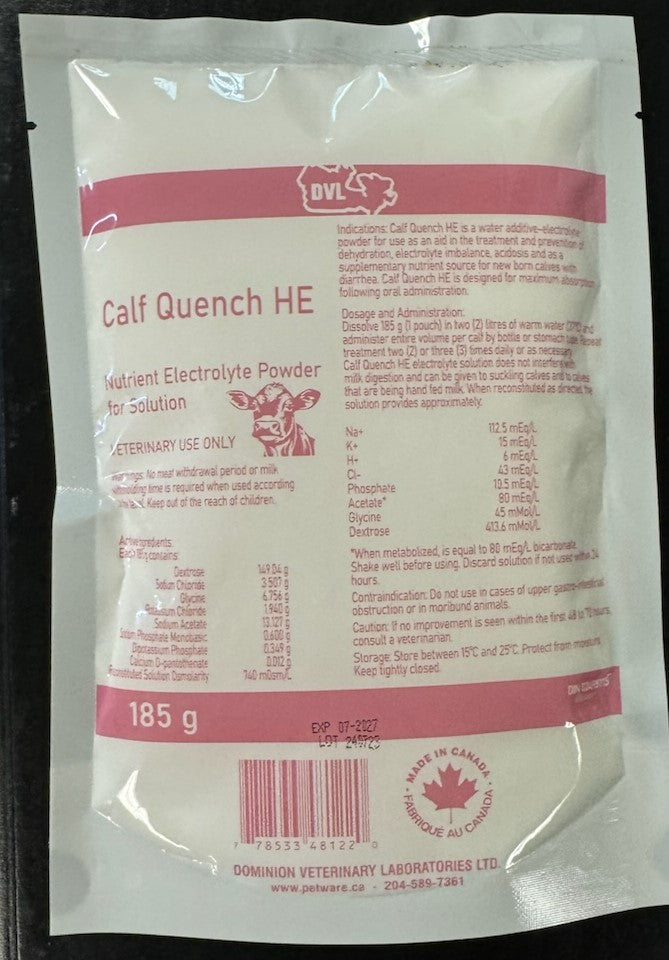
Pre-measured 185 g sachets. Dissolve in 2 L warm water, drench or tube. Repeat 2–3 times daily. Box of 12 sachets.

βœ… Milk-Safe Formula: Does not interfere with milk digestion. Can be given to suckling calves or calves being hand-fed milk β€” no need to withhold milk during treatment.

🧴 Mixing & Administration

  1. 1
    Dissolve β€” mix one 185 g sachet into 2 L of warm water (37Β°C).
  2. 2
    Administer β€” feed via oral drench bottle or esophageal stomach tube.
  3. 3
    Repeat β€” 2–3 times daily based on severity. Discard unused mixed solution after 24 hours.

πŸ§ͺ Active Ingredients (Per 185 g Sachet)

Ingredient Amount Role
Dextrose 149.04 g Immediate energy source for weak and hypothermic calves
Sodium Acetate 13.127 g Alkalinizing agent β€” corrects metabolic acidosis from scours
Glycine 6.756 g Enhances sodium and glucose absorption in the gut
Sodium Chloride 3.507 g Electrolyte replacement
Potassium Chloride 1.940 g Electrolyte replacement
Sodium Phosphate Monobasic 0.600 g Buffering and electrolyte balance
Dipotassium Phosphate 0.349 g Buffering and electrolyte balance
Calcium D-pantothenate 0.012 g B-vitamin support for metabolic recovery

πŸ“¦ Product Details

Pack Size
12 x 185 g sachets
DIN
02495775
Withdrawal
No meat or milk withdrawal required
Regulatory Status
OTC β€” No prescription required
Storage
15Β°C–30Β°C. Protect from moisture. Keep tightly closed.
Manufacturer
Dominion Veterinary Laboratories Ltd. β€” Winnipeg, MB, Canada (Est. 1946)
⚠️ Safety
  • For veterinary use only. Keep out of reach of children.
  • Do not use in cases of upper GI obstruction or in moribund animals.
  • If no improvement within 48–72 hours, consult a veterinarian immediately.